
What is Net Run Rate (NRR) in Cricket?
Net Run Rate (NRR) is a statistical method used in cricket tournaments to rank teams when they have equal points. It calculates the difference between the average runs scored per over and the average runs conceded per over by a team.
NRR becomes extremely important in tournaments like the ICC T20 World Cup, especially during the Super 8 or league stages.
How is Net Run Rate Calculated?
The formula for Net Run Rate is:
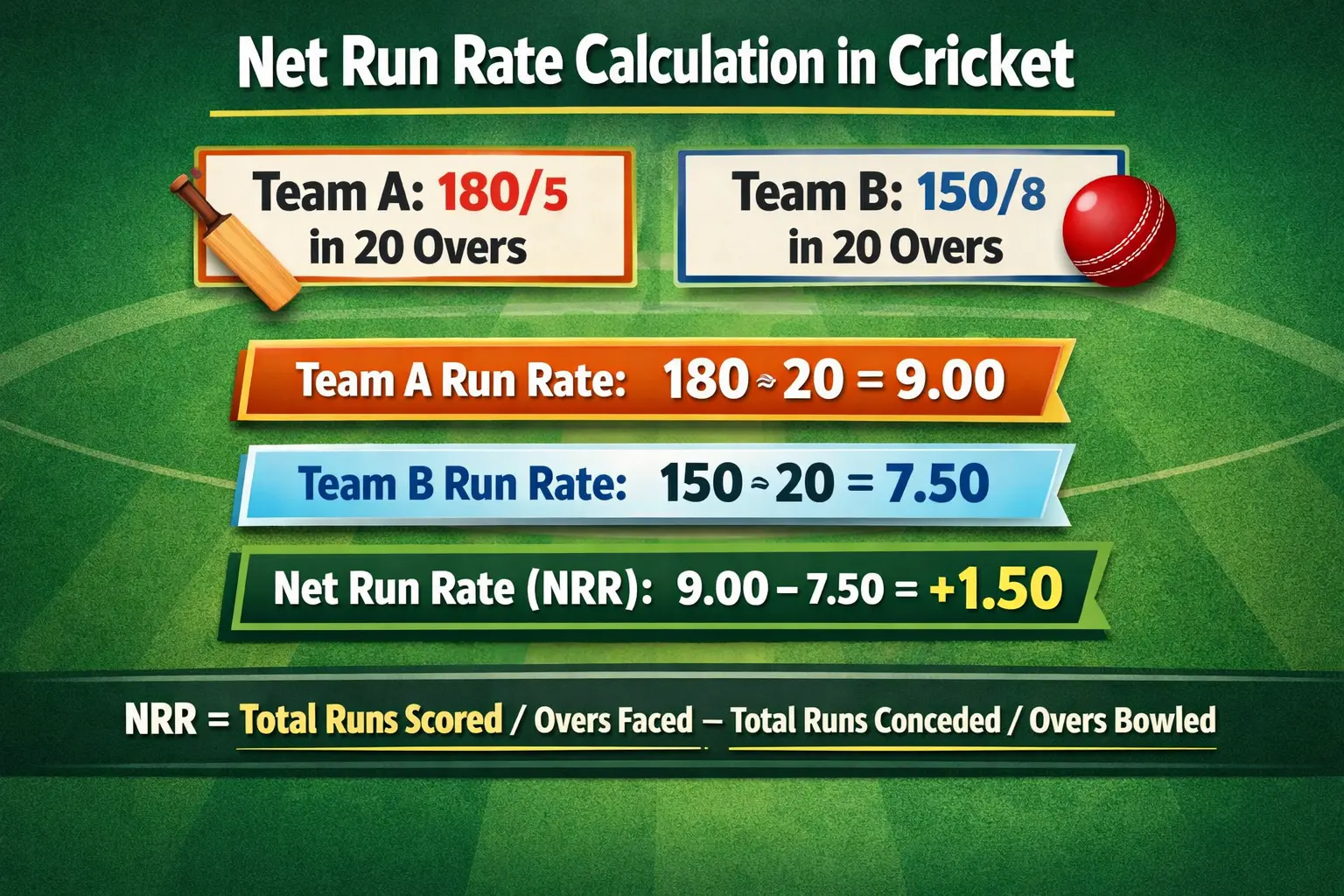
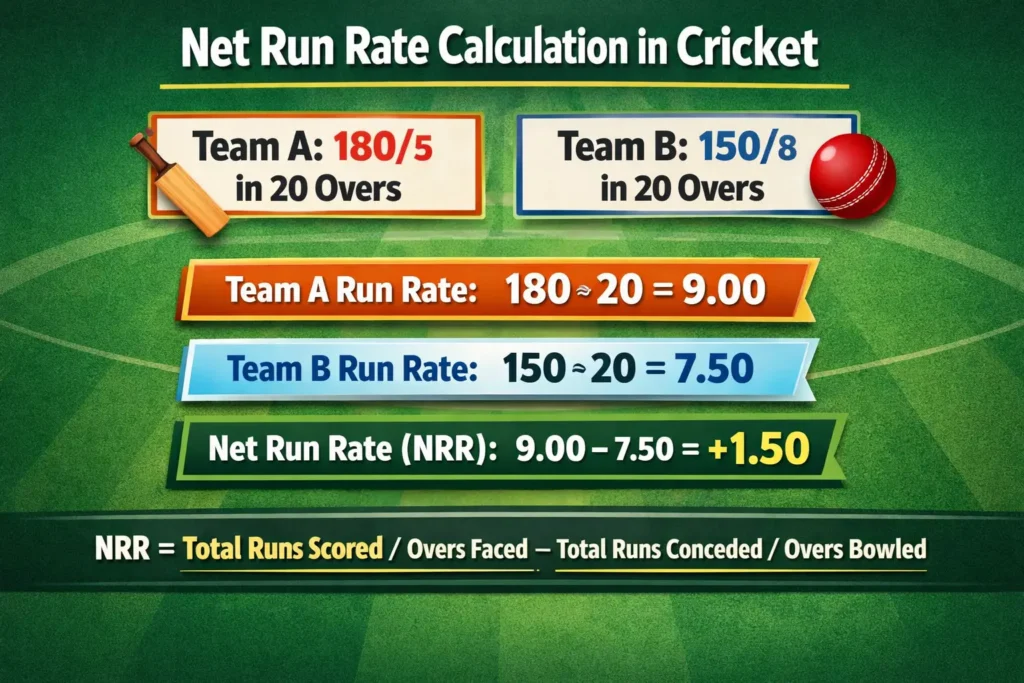
NRR = (Total Runs Scored / Total Overs Faced) – (Total Runs Conceded / Total Overs Bowled)
In simple words:
- If a team scores quickly and restricts opponents, their NRR increases.
- If a team loses by a big margin, their NRR drops significantly.
Example of Net Run Rate Calculation
Let’s take a simple example:
Team A scores 180 runs in 20 overs.
Opponent scores 150 runs in 20 overs.
Team A’s Run Rate = 180 ÷ 20 = 9.00
Opponent’s Run Rate = 150 ÷ 20 = 7.50
NRR = 9.00 – 7.50 = +1.50
That means Team A has a positive Net Run Rate of +1.50.
For example, in the recent India vs South Africa Super 8 match, India were bowled out for 111 while South Africa scored 187. This heavy 76-run defeat significantly reduced India’s Net Run Rate.
Why Net Run Rate is Important in T20 World Cup
In tournaments like the ICC T20 World Cup:
- Teams earn 2 points for a win.
- If two or more teams have equal points, NRR decides ranking.
- A big win improves NRR.
- A heavy defeat hurts qualification chances.
For example, if a team loses by a large margin, their NRR can drop into negative numbers, making semi-final qualification difficult.
Net run rate could play a big role in India’s campaign — read our India vs Zimbabwe Preview 2026 to understand what’s at stake in the Super 8 clash.
What Happens If a Team is Bowled Out Early?
If a team is bowled out in less than 20 overs, the full 20 overs are considered while calculating NRR.
This rule prevents teams from benefiting unfairly from being bowled out early.
How Teams Improve Their NRR
Teams can improve their NRR by:
- Winning matches by large margins
- Chasing targets quickly
- Restricting opponents to low scores
- Bowling out opponents early
Related Match Coverage
- 👉Updated Points Table of T20 Word cup Super 8
- 👉 Latest T20 World Cup Match Reports
- 👉 Watch all matchs live on Jio Hotstar and on Starsports Network
FAQs About Net Run Rate
What is a good Net Run Rate?
A positive NRR above +1.000 is generally considered strong in T20 tournaments.
Can NRR be negative?
Yes. If a team loses heavily, their NRR becomes negative.
Does NRR matter in knockout matches?
No. NRR only applies in league or group stages.
3 thoughts on “How Net Run Rate (NRR) Works in T20 Cricket – Explained with Example”